
Setting the Scene
Diary 1

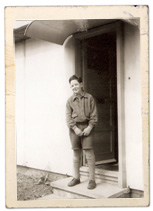 Tens of thousands of prefabs went up after hundreds of thousands of 'real' houses had been knocked down. Between July 1940 and March 1944, half a million homes in Britain were destroyed and a quarter of a million badly damaged. In 1944, the 'Housing (Temporary Accommodation) Act' was passed. Its aim was to provide "a temporary solution to the post-war housing shortage."
In May 1944 a new prefab was put on display - it made a public exhibition of itself - in London's Tate Gallery. Between 1945 and 1949 nearly 160,000 prefabs were transported to sites up and down the country and connected to water mains and electricity cables. There was even futuristic talk of connecting them to telephone lines! For a while a new prefab was going up every twelve minutes. Building materials used included aluminium taken from war planes. Prefabs were fighters from the word go!
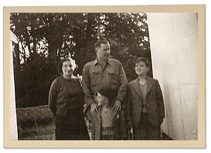 For those living in overcrowded flats or marooned in ex-army barracks, the offer of a prefab came like manna from heaven. While prefabs were initially expected to last for about ten years, most were still in place twenty years later. A few would be standing tall (in a pre-fabricated manner of speaking) in the following century.
Prefab evolution has generally followed the neo-Darwinian principle of 'survival of the flattest'. The dominant style of pre-fabricated design in Britain has been straight-lined ('Euclidean') and rectangular. In the United States dome-shaped and geodesic prefabs have been popular - so much so that one commentator declared: "I have seen the prefab future and it is round!"
Prefabs lend themselves towards communitarian living. Like buffalo they prefer to cluster together in herds. With their low carbon footprints prefabs could make a dramatic contribution to solving the global crisis in housing and over-crowding.
Select Another Diary
Setting the scene
Tens of thousands of prefabs went up after hundreds of thousands...
The prefabs go up in Bath
The bombing of Bath on the 25th and 26th April 1942 was part of the Baedecker...
Twilight falls on the prefabs
Prefabs had pale exteriors, a compact functional form, and kitchens and...
The end of an era
Six hundred families at Bath are anxiously waiting to know what is to be the...
A salute to the prefabs
Moving the residents out of the prefabs was a straightforward operation...
A prefab case study
Between 1946 and 1948 around 600 prefabs were built in Bath...
A panoramic view from the top of a Twerton prefab
Climb on to the top of our corrugated coal house in the...
Letters to the prefabs from Australia
I suppose by now you'll be back at school. I hope you were satisfied with your...
Send any comments on the Prefab Diaries to: twerton303@gmail.com